The oldest motorcycle still registered in Luxembourg is 106 years old. Between this witness from another era and the 29,021 motorcycles recorded in 2025, a fleet takes shape: premium in character, ageing gracefully, and still a long way from the electric transition.
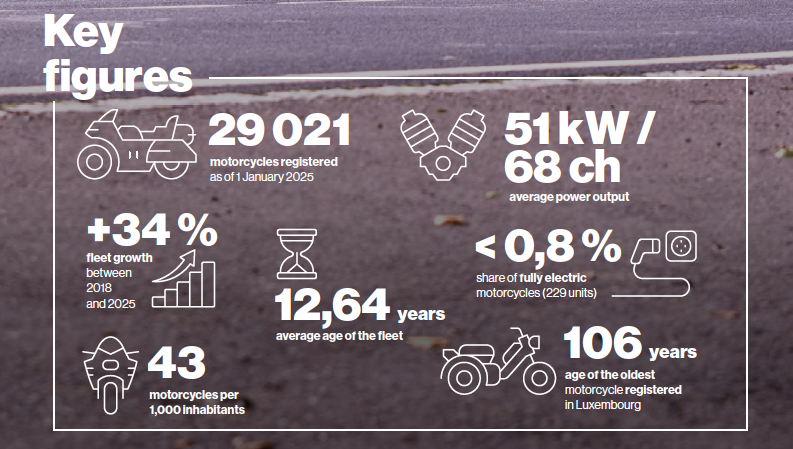
As of 1 January 2025, Luxembourg had 29,021 registered motorcycles, including scooters. This figure is provided by the Société nationale de circulation automobile (SNCA), which holds usable data going back to 2018. Over seven years, the fleet has grown by 34%, rising from 21,674 units at the earlier reference date. Growth has been steady and uninterrupted, averaging between 500 and 1,300 additional units per year depending on the year, with a slight deceleration since 2023.
Relative to the resident population, the fleet represents approximately 43 motorcycles per 1,000 inhabitants, placing the Grand Duchy around the average for Northern and Western European countries. At European level, Italy and Greece stand clearly apart from the rest, largely due to the deeply ingrained role of two-wheelers in everyday mobility habits. Greece tops the rankings at 100 motorcycles per 1,000 inhabitants. Germany and Austria, which share a comparable leisure-riding culture with Luxembourg, stand at around 46 units per 1,000 inhabitants. Luxembourg thus occupies a position similar to its immediate neighbours, without standing out from the crowd.
The SNCA reports that the average age of the fleet is 12.64 years, a figure consistent with trends observed in other European countries where motorcycling is primarily a leisure pursuit and machines are kept for an extended period.
The average power of the fleet stands at 51 kW, or approximately 68 horsepower. This level indicates a predominance of mid-range and larger-displacement motorcycles, which is consistent with the typical profile of a high-income country where motorcycles are purchased more for pleasure than necessity.
In terms of energy, the transition to electric remains very limited. Of the 29,021 registered motorcycles, 28,789 are petrol or diesel-powered, 3 are hybrids, and 229 are fully electric, accounting for less than 0.8% of the total fleet. This observation extends beyond Luxembourg’s borders: at European level, electric two-wheeler sales fell in 2024, with volumes for segments equivalent to 125 cc and above declining by more than 18.5% year-on-year, as public authorities have tended to reduce purchase subsidies. Range limitations and the pricing of electric models remain persistent barriers that the market has yet to overcome.
The question of whether Luxembourg is “a motorcycle country” deserves a nuanced answer. The fleet has grown continuously for at least seven years, within a broadly favourable European context. Over a five-year horizon, the European motorcycle market has recorded growth of around 22%, with sales of motorised two-wheelers above 50 cc rising from 500,252 units in 2019 to over 610,000 in 2024 across the five major markets. Luxembourg is following this general trend. Its motorcycle motorisation rate, at around 43 per 1,000 inhabitants, places it above France but below countries with a strong motorcycling tradition. The average power of the fleet and the controlled ageing of machines both point towards a leisure rather than utilitarian profile, which is consistent with the Grand Duchy’s socioeconomic reality. In the absence of any discernible acceleration in electrification, the combustion-engine motorcycle will remain, for the foreseeable future, the dominant feature of Luxembourg’s motorised two-wheeler landscape.
The oldest is 106 years old
According to SNCA data, the oldest motorcycle still registered in Luxembourg dates from 1919: it is an F.N. (Fabrique Nationale de Herstal, Belgium), making it a 106-year-old machine. Internationally known for arms manufacturing, FN nevertheless has a rich history in the two-wheeler sector. From 1901, the brand marketed its first single-cylinder motorcycle. In 1905, it launched the world’s first four-cylinder inline motorcycle — a remarkable technical achievement for the era. The company achieved significant commercial success across Europe and in export markets until the 1960s, at which point motorcycle production was gradually phased out in favour of armaments.
Tags