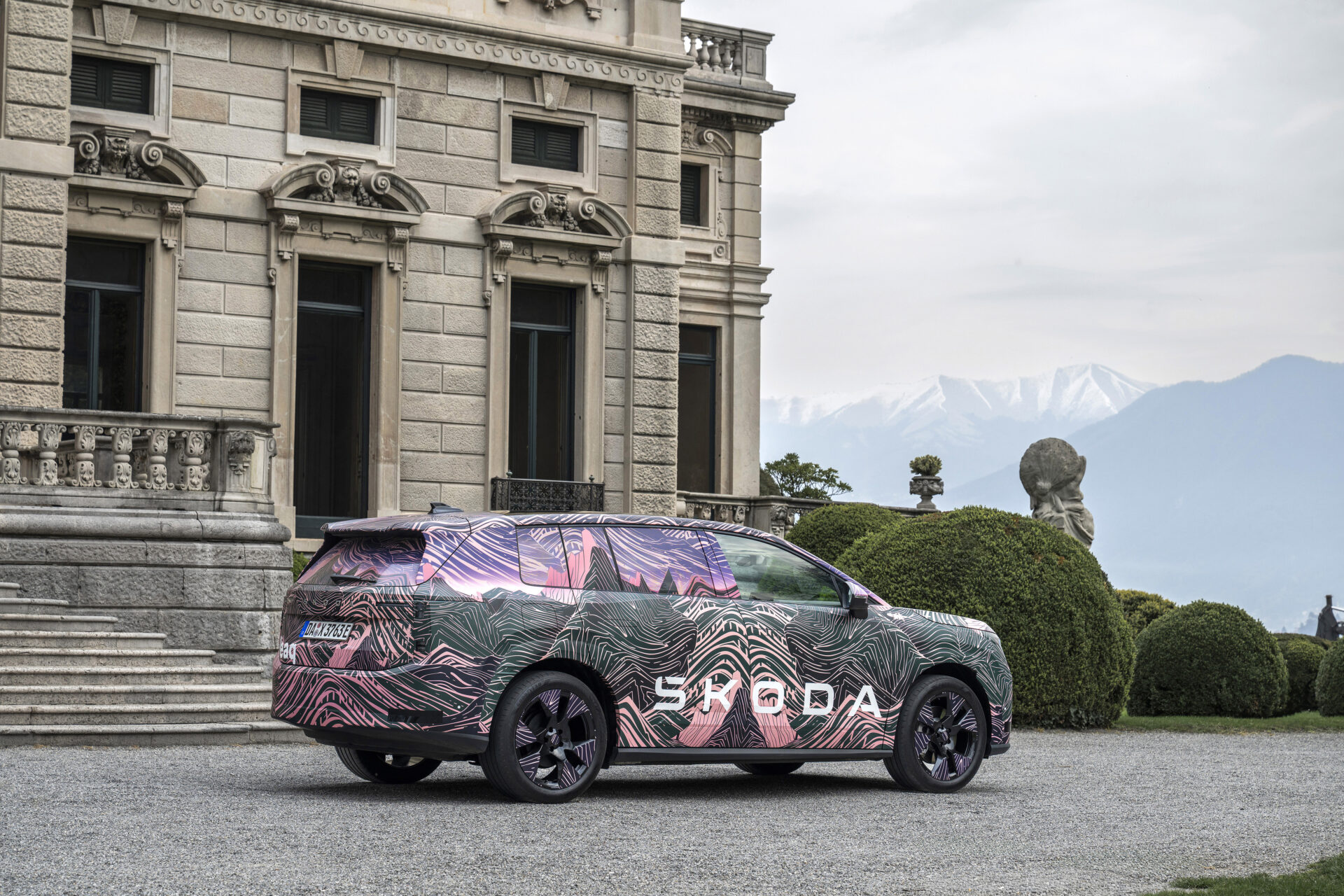
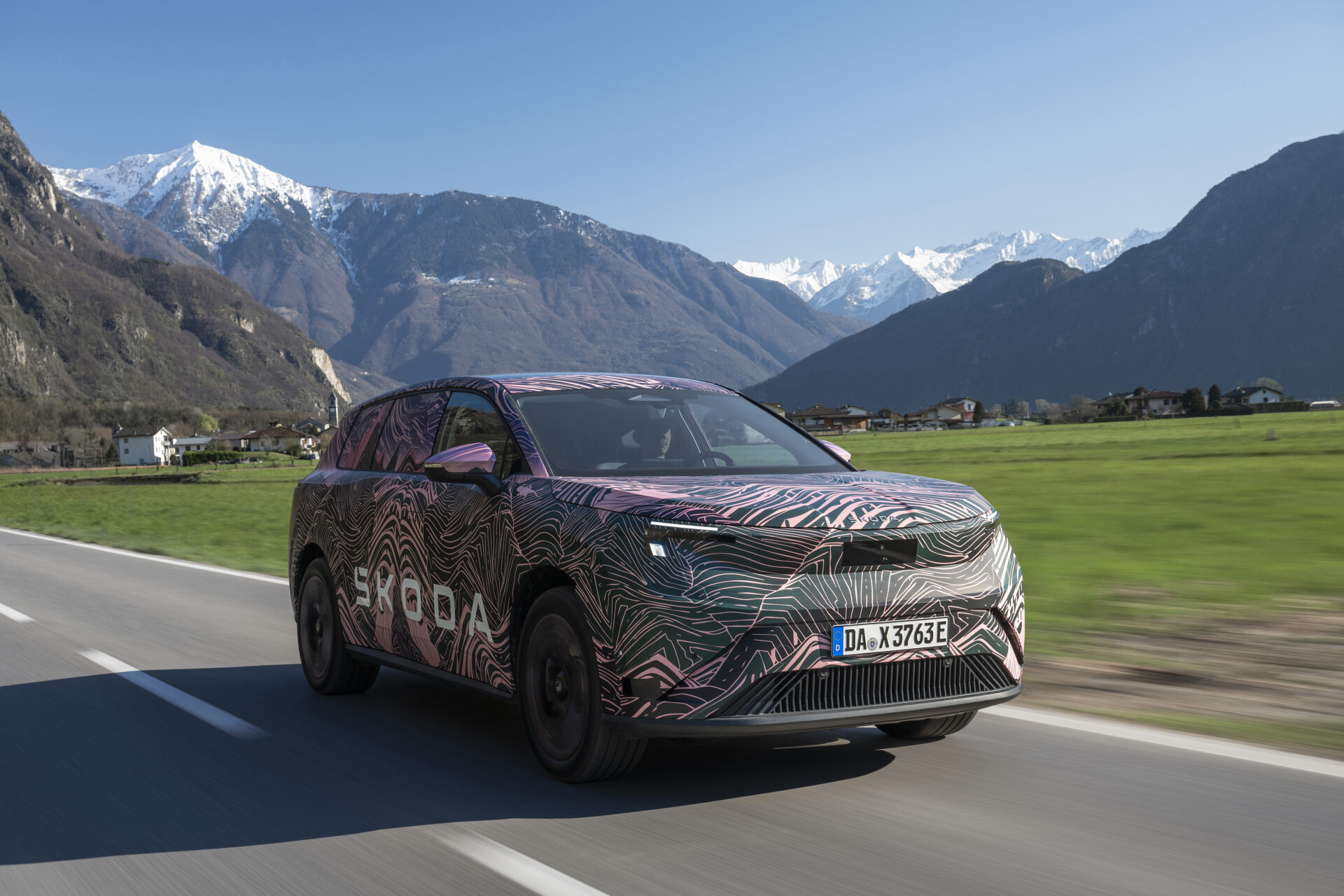
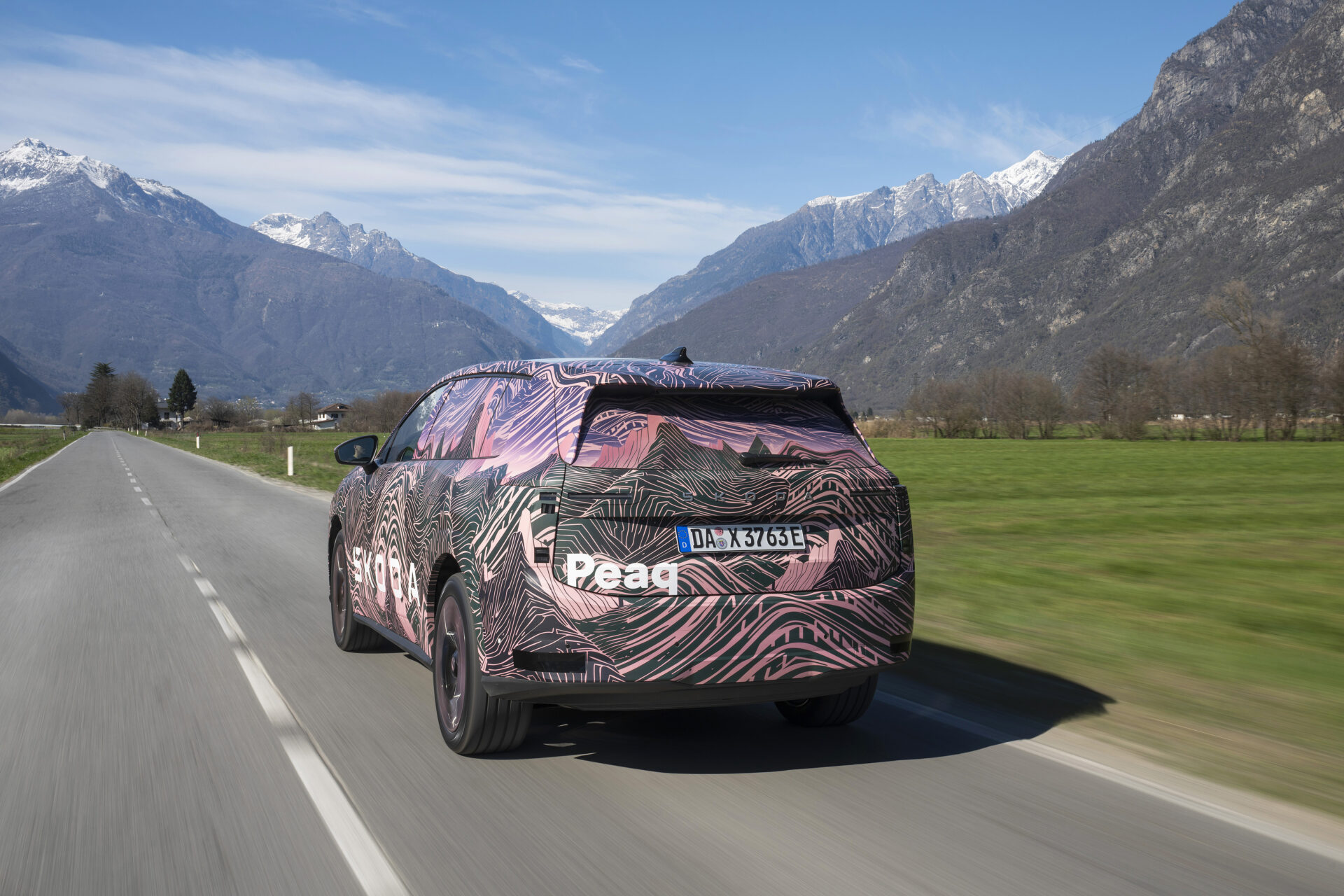
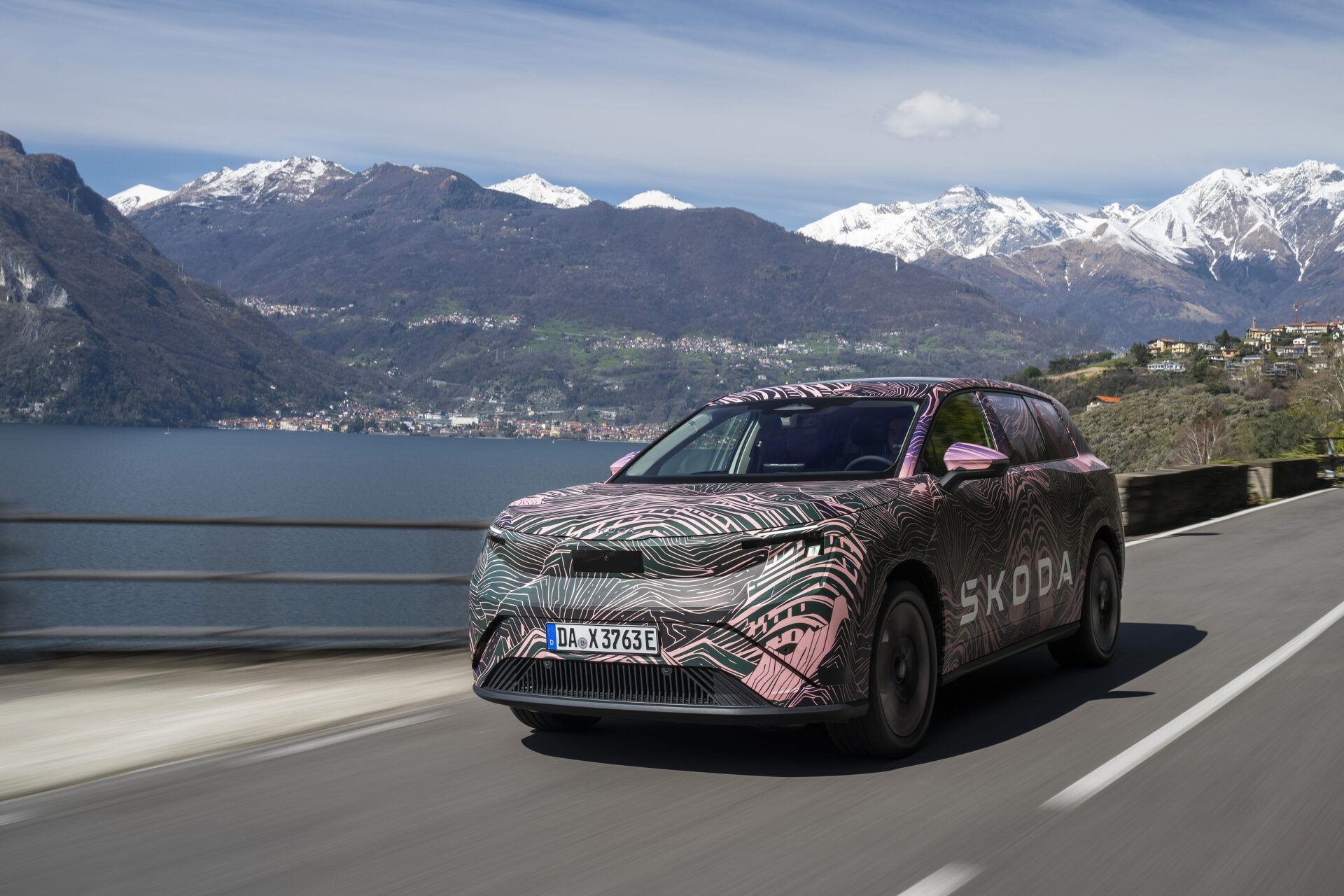
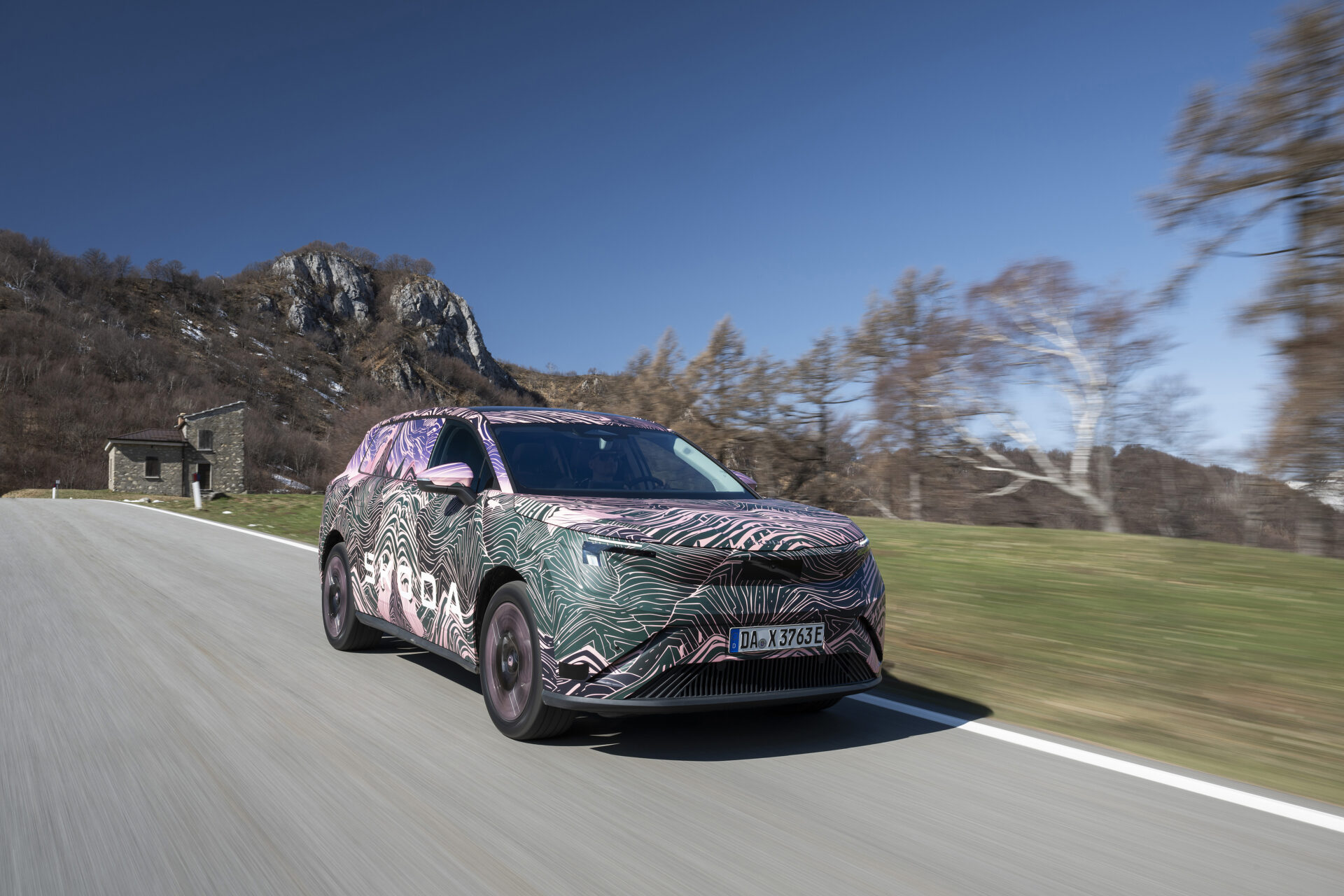
With the Peaq, Škoda is preparing to top its range with a large seven-seat electric SUV. The Czech manufacturer opened the doors of a fully camouflaged pre-production model for a first hands-on experience. An opportunity to assess a vehicle that will inaugurate next summer the very top of the brand’s catalogue.
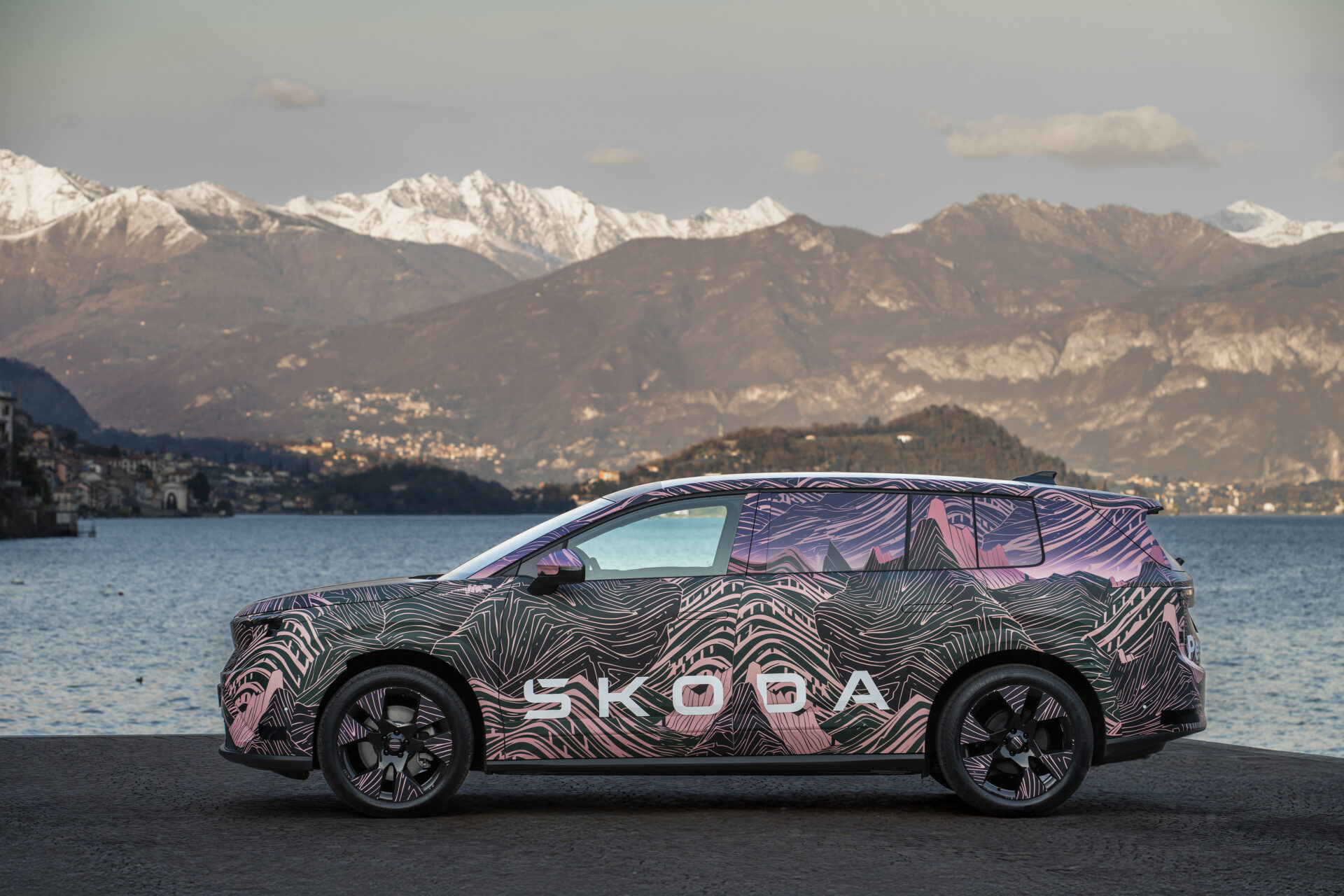
The Peaq immediately makes its size felt. At 4.87 m long and 1.66 m tall, it is 12 cm longer than the combustion-powered Kodiaq, and its 2.97 m wheelbase frees up an interior volume previously unseen at the brand. This wheelbase difference is no detail: it directly enables the integration of a genuine third row. The SUV is offered in five- or seven-seat configurations.
In the five-seat version, with the rear seats in place, boot capacity reaches 1,010 litres, the highest figure ever offered on a Škoda model and around 100 litres more than the Kodiaq. The seven-seat configuration retains 299 litres, supplemented by a 37-litre front compartment under the bonnet. The brand also claims the largest panoramic roof in its history, divided into nine segments with electronically adjustable tinting.
A “Modern Solid” silhouette
Despite the camouflage, the proportions remain readable. The Peaq adopts the “Modern Solid” design language introduced by the Vision 7S concept in 2022. The front end features a glossy black Tech-Deck panel backlit by fine vertical slats, framed by Full Matrix LED headlights with eighteen segments. In profile, the flush door handles, a first for the manufacturer, retract into the bodywork to optimise aerodynamics. Wheels range from 19 to 21 inches depending on the trim, and ten exterior colours are offered in the catalogue.
Cabin: the brand’s signature
Inside, the Peaq remains true to Škoda’s DNA. The presentation favours functional simplicity, with perceived quality consistent with the manufacturer’s current standards. The 10-inch digital cluster faces a 13.6-inch vertical infotainment screen running Android, compatible with Spotify, YouTube and Google Maps. An augmented-reality head-up display is available as an option.
Five interior atmospheres are planned, including a Sportline trim. The Suite versions feature Techtona upholstery, a quality leather alternative, available in black or light grey Ceramique. Some configurations are entirely free of animal-origin materials and incorporate more than 50 kg of recycled content. The optional Relax Package introduces AGR-certified seats with massage function, electric leg rests, a folding table and a wellness app that controls climate, ambient lighting and massage functions. The pack also debuts an audio system developed in collaboration with Sonos, a first in the automotive world for the American specialist.
Three powertrains on the MEB platform
The Peaq is built on the Volkswagen Group’s MEB platform, used here in its longest configuration, and is produced in Mladá Boleslav. Three configurations are announced. The 60 version uses a 63 kWh battery for 150 kW (204 hp) and a range of more than 460 km in rear-wheel drive. The 90 version steps up to 91 kWh and 210 kW (286 hp), with more than 600 km of WLTP range, also rear-wheel drive. The 90x adds a second motor for all-wheel drive at 220 kW (299 hp) and dispatches the 0-100 km/h sprint in 6.7 seconds, with no significant impact on range.
DC fast charging from 10 to 80% takes less than 28 minutes on the 90 versions, and under 27 minutes on the 60. Weight is around 2,300 kg, a substantial figure but consistent with the size and battery capacity. Note that, unlike several direct competitors, the Peaq operates on a 400-volt architecture, while the segment is gradually migrating to 800 volts.
Behaviour: comfort first
On the first roads driven in the pre-production version, the Peaq proves surprisingly manoeuvrable for its size. The 9.9 m turning radius makes urban manoeuvres easier. The steering is precise without aiming for sportiness, in line with a family SUV approach. The damping correctly filters out road imperfections and delivers a more than satisfactory performance for a pre-production unit. The low centre of gravity, a consequence of the battery being housed in the floor, contributes to a reassuring stance. The cruising-speed silence stands out as one of the highlights of this first encounter.
Provisional verdict
On the basis of this first contact in camouflaged pre-production form, the Peaq points to a serious large electric SUV, faithful to Škoda’s pragmatic philosophy and built for intensive family use. Cabin space, boot volume and manoeuvrability are strong arguments. Real-world consumption, definitive long-distance behaviour and pricing positioning, which the manufacturer has not yet announced, remain to be confirmed. Sales are expected for autumn 2026.
Technical specifications – Škoda Peaq
Version 60 (rear-wheel drive)
Power: 204 hp (150 kW)
Battery capacity: 63 kWh
WLTP electric range: over 460 km
Weight: approx. 2,300 kg
Version 90 (rear-wheel drive)
Power: 286 hp (210 kW)
Battery capacity: 91 kWh
WLTP electric range: over 600 km
Weight: approx. 2,300 kg
Starting price: not disclosed
Version 90x (all-wheel drive)
Power: 299 hp (220 kW)
Battery capacity: 91 kWh
WLTP electric range: over 600 km
Weight: approx. 2,300 kg