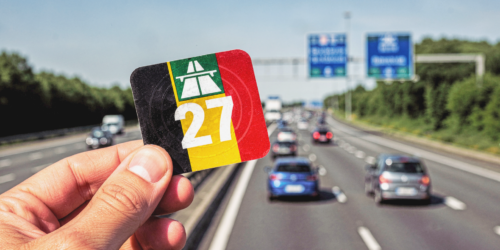
From 1 May 2027, driving on Belgian motorways will cost between €90 and €125 a year depending on the vehicle’s CO2 emissions, a measure agreed by the three Regions on 10 July 2026. Is this rate harsh or reasonable, compared with the vignettes and tolls already in force elsewhere in Europe?
Driving on a motorway in Europe follows three distinct systems. Seven countries (Austria, Bulgaria, Czechia, Hungary, Romania, Slovakia, Slovenia), soon eight with Belgium, apply a time-based vignette: a flat fee giving unlimited access to the network for a chosen period, with no link to the number of kilometres actually driven. Seven others (France, Italy, Spain, Portugal, Greece, Croatia and, now only residually, Poland) charge a toll proportional to distance. Ireland is a special case, with fixed-point tolls unrelated to distance. The twelve remaining countries, from Germany to the Baltic states by way of the Netherlands and Luxembourg, levy no general charge on private cars.
The price of vignettes: from €43 to more than €170 a year
Comparing the headline price of an annual vignette for a private car, Switzerland, though outside the Union, remains the benchmark, with a rate of 40 Swiss francs, about €43, unchanged for years. Within the EU27, Bulgaria (€49.60) and Romania are the cheapest; the latter overhauled its scale on 1 July 2026, now indexed to the vehicle’s emissions standard, from €48 for an electric or Euro VI car to €63 for an older model. At the other end, Hungary brings up the rear at €160 to €173 depending on the forint exchange rate.
The future Belgian vignette, announced at between €90 and €125 depending on the vehicle’s emissions, would sit in the upper half of this ranking for the annual option. At its lowest rate (€90 for an electric car) it would match Slovakia. At its highest (€125 for a vehicle registered before 2005) it would draw level with Hungary, today the most expensive vignette in the Union. Like the eight other countries, Belgium will also offer short-term options, likewise indexed to emissions: from €8.10 to €11.25 for one day, from €10.80 to €15 for ten days, up to €27 to €37.50 for two months. The lowest daily rate thus matches Slovakia’s exactly. It is worth noting that Switzerland, which has the cheapest vignette, offers no short-term option: even for a single day, the annual vignette must be paid.
| Rank | Country | 1 day | Short term | Annual |
| 1 | Switzerland (non-EU) | — | none | ~€43 (CHF 40) |
| 2 | Bulgaria | €4.09 | €5.11 (w/e) / €7.67 (week) | €49.60 |
| 3 | Romania | ~€4.20 | ~€5.70 (10 days) | €48 to €63 (by EURO standard) |
| 4 | Slovakia | €8.10 | €10.80 (10 days) | €90 |
| 4 | Belgium (from 2027) | €8.10 to €11.25 | €10.80 to €15.00 (10 days) | €90 to €125 |
| 5 | Czechia | €9.40 | €12.30 (10 days) | ~€105 |
| 6 | Austria | €9.60 | €12.80 (10 days) | €106.80 |
| 7 | Slovenia | — | €16.00 (week) | €117.50 |
| 8 | Hungary | ~€15.50 | ~€19.30 (10 days) | ~€160 to €173 |
Set against the network, the ranking is reversed
Taking the comparison a step further, the focus turns to the value of the vignette relative to the extent of the network. Hungary, which has the highest rate (€160 to €173 for the annual vignette), drops back to mid-table once set against its extensive network, at a cost of €0.09 per kilometre. Conversely, Slovenia and Slovakia become the most expensive in Europe, at €0.191 and €0.173 per kilometre, because their motorway networks, at around 600 kilometres, are among the shortest in the Union. Belgium, which has one of the densest networks on the continent (1,763 kilometres), would come in at €0.051 to €0.071 per kilometre, one of the lowest figures in Europe.
| Rank | Country | Annual price | Network (km, Eurostat) | Price per km of network per year |
| 1 | Switzerland (non-EU) | ~€43 | 1,544 | €0.028 |
| 2 | Belgium (proj. 2027) | €90 to €125 | 1,763 | €0.051 to €0.071 |
| 3 | Romania | €48 to €63 | 920 | €0.053 to €0.068 |
| 4 | Austria | €106.80 | 1,749 | €0.061 |
| 5 | Bulgaria | €49.60 | 806 | €0.062 |
| 6 | Czechia | ~€105 | 1,298 | €0.081 |
| 7 | Hungary | ~€160 to €173 | 1,774 | €0.090 to €0.098 |
| 8 | Slovakia | €90 | 521 | €0.173 |
| 9 | Slovenia | €117.50 | 616 | €0.191 |
Tolls: France remains out in front
In toll-based countries the reasoning is more direct: you pay per kilometre actually driven. Here too, received wisdom does not hold up against the figures. France, at €0.09 to €0.14 per kilometre, charges one of the highest rates in Europe. The gap with other countries such as Spain (€0.09 to €0.12 per kilometre) and Poland (€0.10 to €0.13) is nonetheless sometimes fairly small. It should be noted, however, that Spain and Poland are no longer really toll countries in the traditional sense: Spain now has only 8 per cent of its motorway network subject to tolls after the removals of 2020-2021, and Poland made most of its state motorways free in 2023, keeping only three concession sections.
Conversely, Greece and Croatia form the most affordable pair, below the €0.07 mark. As for Ireland, its system of fixed-point tolls (a flat charge per crossing, unrelated to distance) makes it impossible to rank in this table.
One could go further still and point out that Denmark and Sweden run a free network but charge for two major bridges: the Storebælt (€35 to €52 per crossing for a car) and the Øresund (€60 to €120).
| Rank | Country | Price per km (car) | Extent of the tolled network |
| 1 | Greece | €0.04 to €0.05 | Almost the entire concession network (Egnatia Odos, new concession from 01/01/2026) |
| 2 | Italy | €0.05 to €0.12 | Almost the entire network (lowland cheaper than mountain) |
| 3 | Croatia | €0.06 to €0.065 | Almost the entire HAC network |
| 4 | Portugal | €0.08 to €0.09 | Remaining concession network, after around 800 km of former SCUT roads were freed from January 2025 |
| 5 | Spain | €0.09 to €0.12 | Only 1,435 km out of 17,228 km of motorway network (~8 per cent) |
| 6 | France | €0.09 to €0.14 | Historic concession network, the majority |
| 7 | Poland | €0.10 to €0.13 | Three residual concession sections (A1, A2, A4); the rest free since 2023 |
| — | Ireland | Fixed charge per crossing (€2.60 to €3.80 on the M50) | ~11 toll points over ~900 km; cannot be ranked per km |
Vignettes and tolls combined: the grand ranking per kilometre
Setting everything against the kilometre, vignettes as well as tolls, produces a single ranking that must nonetheless be read with care: for toll countries it is the price actually paid per kilometre driven; for vignette countries it is the cost of the flat fee set against each kilometre of available network. The two measures do not capture the same thing, but placing them side by side gives an order of magnitude not seen before.
The upshot: Switzerland remains the cheapest country to drive in, closely followed by Greece. The future Belgian vignette slots in among the cheapest countries, alongside Romania, Croatia, Austria and Bulgaria.
Set against the network, then, Belgium comes out well: thanks to one of the densest networks on the continent, its cost per kilometre of network is among the lowest in Europe, just behind Switzerland. And compared with tolls, the Belgian vignette quickly becomes worthwhile for those who drive a lot: its price is equivalent to about 780 to 1,090 kilometres of tolled motorway in France, barely more than a one-way trip from Brussels to Marseille. Beyond that annual distance, the Belgian motorist pays proportionally less than a French neighbour. In short: steep on the price tag, the Belgian vignette turns out to be fairly measured once set against actual use of the network.
A neat coincidence to close: however you do the sums, the European average comes out at around nine cents per kilometre. Tolls alone work out at €0.088, vignettes alone at €0.090, and the two combined at €0.089. Three different methods, one shared order of magnitude: driving on a charged network in Europe costs, on average, about nine cents per kilometre.
| Price per km | Country | Type | What the figure measures |
| €0.028 | Switzerland | Vignette | Cost of the pass per km of available network |
| €0.04–0.05 | Greece | Toll | Paid per km actually driven |
| €0.051–0.071 | Belgium (2027) | Vignette | Cost of the pass per km of available network |
| €0.053–0.068 | Romania | Vignette | Cost of the pass per km of available network |
| €0.06–0.065 | Croatia | Toll | Paid per km actually driven |
| €0.061 | Austria | Vignette | Cost of the pass per km of available network |
| €0.062 | Bulgaria | Vignette | Cost of the pass per km of available network |
| €0.08–0.09 | Portugal | Toll | Paid per km actually driven |
| €0.081 | Czechia | Vignette | Cost of the pass per km of available network |
| €0.05–0.12 | Italy | Toll | Paid per km actually driven |
| €0.090–0.098 | Hungary | Vignette | Cost of the pass per km of available network |
| €0.09–0.12 | Spain | Toll | Paid per km actually driven |
| €0.09–0.14 | France | Toll | Paid per km actually driven |
| €0.10–0.13 | Poland | Toll | Paid per km actually driven |
| €0.173 | Slovakia | Vignette | Cost of the pass per km of available network |
| €0.191 | Slovenia | Vignette | Cost of the pass per km of available network |
Sources: ASFINAG, DARS, eDálnice, Nemzeti Útdíjfizetési Szolgáltató, CNAIR, NDS, BGTOLL, Autostrade per l’Italia, Ministerio de Transportes (Spain), Infraestruturas de Portugal, Hrvatske autoceste, GDDKiA, Transport Infrastructure Ireland, Federal Office for Customs and Border Security (Switzerland), Belgian regional governments, Eurostat / European Union Road Federation. Data as of July 2026. Conversions at mid-July 2026 rates (€1 ≈ CZK 24.2, HUF 357, RON 5.24, CHF 0.925); amounts in foreign currencies vary with the exchange rate. Rates subject to annual indexation.