Comfort, reliability, price, protection, deployment speed: over several weeks, five instructors from the Maison du Motard each wore a different motorcycle airbag vest to evaluate its everyday performance. Bering, Dainese, Alpinestars and Helite were all put to the test.
Not so long ago, the motorcycle airbag vest was a niche accessory, reserved for competitive riders or the most cautious motorcyclists. Today, the technology has become widely accessible: prices have fallen, systems have grown more refined, and European certifications now strictly govern protection levels. The question remains: which one to choose? To answer it, we handed five models to five testers, following a shared protocol — at least seven days of real-world use on varied routes (urban, motorway, winding roads, degraded surfaces) and a common evaluation grid.
Our selection deliberately focused on the most popular models among Luxembourg’s motorcycling community, and exclusively on vests available for purchase in local shops. The five selected candidates cover a broad spectrum: the Bering Protect Air Evo, the only cable-operated model in the lineup, priced under 350 euros; the Dainese Smart Air, a premium connected vest; the Alpinestars Tech-Air 3 V2 and Tech-Air 5 Plasma, representing two different philosophies within the same brand; and the Helite E-Turtle 2, which relies on satellite GPS connectivity. One point deserves mention from the outset: all these vests cover classic moving accidents, but when it comes to a stationary rider being struck — at a stop sign, in traffic, or while waiting at a red light — responses vary considerably. This is one of the key areas of analysis in this comparison.
Bering Protect Air Evo – Unkomplizierter Einstieg
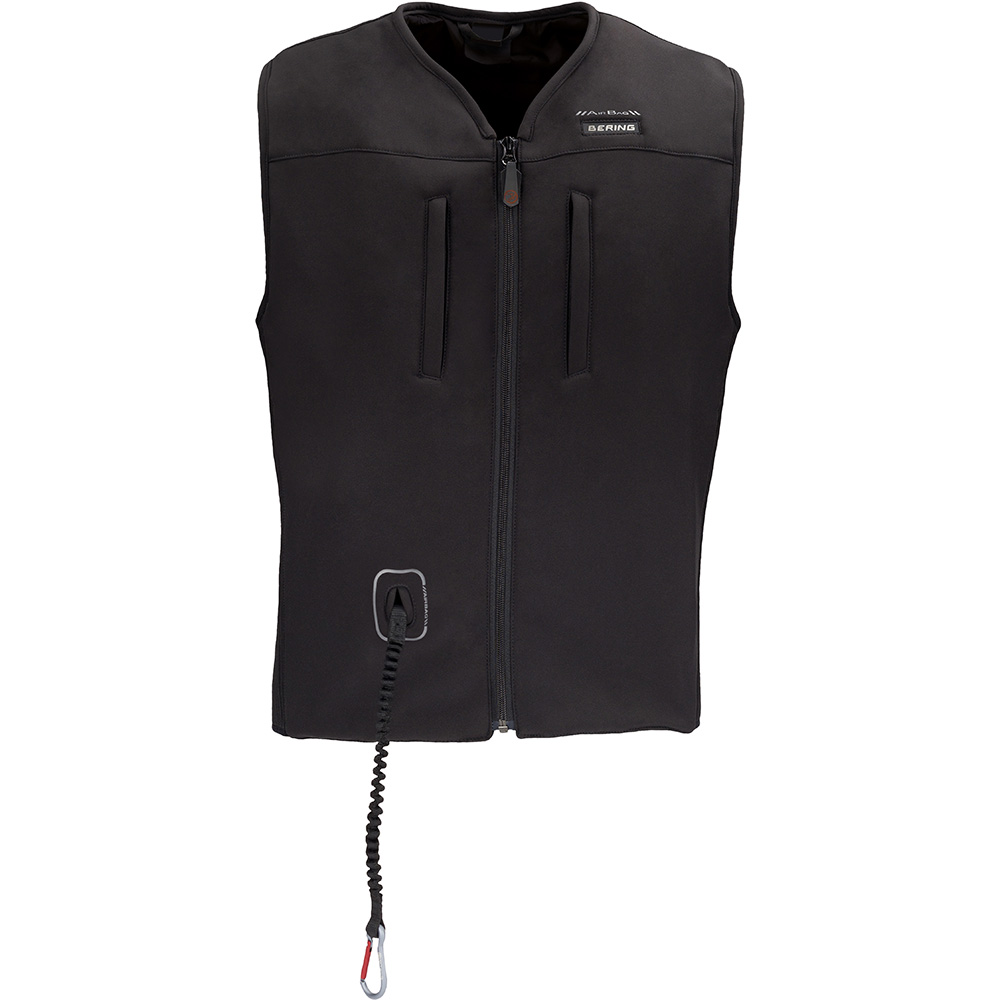
Mit 345 Euro ist die Bering die günstigste Weste im Test. Das Prinzip ist einfach: Eine Art Reißleine verbindet die Weste mit dem Motorrad. Bei einem Sturz löst der Mechanismus innerhalb von 100 Millisekunden aus. Der Fahrer muss weder darauf achten, ob eine Batterie geladen ist, noch eine App installieren oder ein Abonnement abschließen. Allerdings muss er das Band in Kauf nehmen: Drei Metallösen zur Befestigung können den Tank beschädigen und der Wechsel von einem Motorrad zum anderen ist etwas umständlich.
Was die geschützten Körperbereiche anbelangt, braucht sich die Bering nicht zu verstecken: Sie deckt Brustkorb, Rücken, Wirbelsäule, Bauchraum, Halswirbelsäule und Steißbein ab. Daher erhält sie in dieser Kategorie die Höchstnote: 5 von 5 Punkten. Auch in Sachen Komfort schneidet sie so gut ab: Die Softshell-Weste ist angenehm zu tragen, leicht (1.278 g) und unauffällig. Vier von fünf Punkten gibt es jeweils für ihr geringes Gewicht und ihren Preis. Der einzige Minuspunkt: Damit der Airbag auslöst, muss der Fahrer in Bewegung geraten. Bei einem Aufprall – etwa, wenn ein Auto das stehende Motorrad anrempelt – reagiert die Weste nicht.
Gewichtete Endnote: 17,0/20. Die große Überraschung im Test: Das günstigste Modell setzt sich an die Spitze dank seiner Stärke in nahezu allen Testkategorien.
Bering Protect Air Evo — A straightforward entry point
At 345 euros, the Bering is the least expensive vest in the test. Its principle is as simple as it gets: a lanyard connects the vest to the motorcycle, and in the event of a fall, triggers the mechanism in 100 milliseconds. No battery to monitor, no app to install, no subscription. In return, you must accept the constraints of a lanyard: the three metal clips may scratch the fuel tank, and transferring from one motorcycle to another is a genuine inconvenience.
In terms of protection, the Bering has nothing to be ashamed of: it covers the chest, back, spine, abdomen, neck and coccyx, earning a maximum score of 5/5. Comfort follows with 5/5: the softshell vest is pleasant to wear, lightweight (1,278 g) and discreet. Its low weight earns a 4/5, and its price another 4/5. The one structural limitation worth noting: the cable system requires a physical throw of the rider to deploy the airbag. In the event of a stationary impact — a car rear-ending a stopped motorcyclist — the vest will not respond.
Weighted final score: 17.0/20. The great surprise of the test: the most affordable model takes the top spot thanks to its excellence across nearly all criteria as defined by our methodology.
Dainese Smart Air — Connected and fast
The Dainese Smart Air records the shortest deployment time in the lineup: 45 milliseconds, the best result in the comparison (5/5). It is operational from 10 km/h and stands out for its activation via a dedicated push-button — not to be confused with the Alpinestars models, which activate automatically when the zip is fastened. Once activated, the vest performs a self-diagnostic, and you are ready to go. CE Level 2 certified, it handles stationary impacts — the scenario of a third-party collision without any rider movement.
On the downside: the 12-hour battery life is the shortest in the comparison, a real handicap in our scoring (1/5). When the battery runs low, the vest vibrates continuously. Protection, though solid, does not cover the neck area. Its list price of 649 euros, plus 119 euros for the cartridge after deployment, also earns just 2/5. Its modest weight of 1,480 g (4/5) and the quality of its app interface partially offset the negatives.
Weighted final score: 13.9/20. The fastest vest in the test, but significantly penalised by its insufficient battery life.
Alpinestars Tech-Air 3 V2 — Room for improvement
Testing the Alpinestars Tech-Air 3 V2 began with a poor purchase experience. The salesperson was unfamiliar with the vest’s “delivery mode” — which requires manually connecting the battery before first use — nor with the need to align the closing magnets to activate the system. He was also unaware that a factory return is mandatory every three deployments and every two years. Important information for the end user.
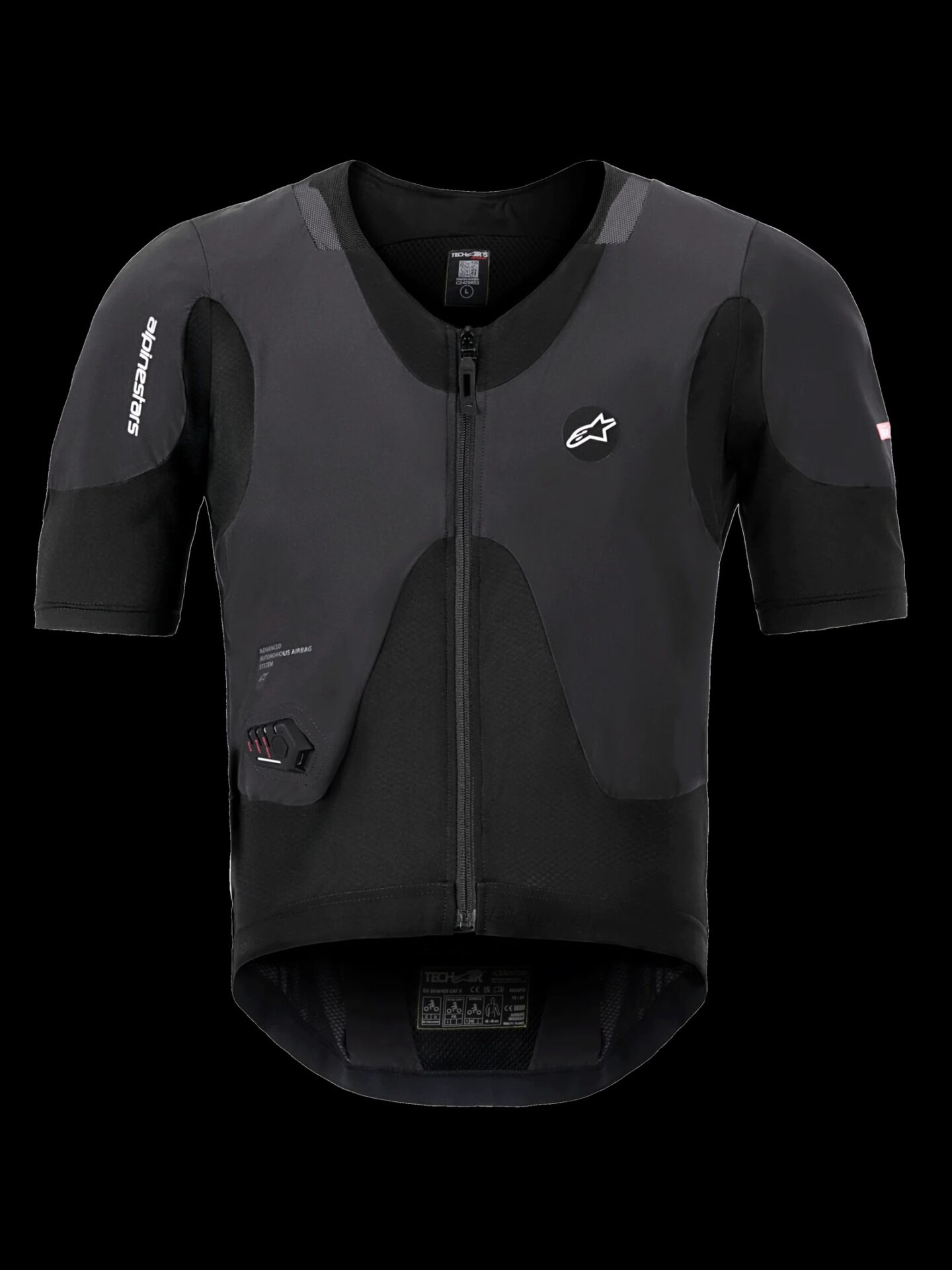
On the road, the Tech-Air 3 V2 experienced a notable incident: during one outing, the vest failed to start despite a full charge and correct closure — the day after a software update. This type of malfunction can be quite disruptive. That said, the model’s positives are real: automatic activation when the zip is fastened is a genuine convenience, it handles stationary impacts, and its 40-hour battery life earns a solid 4/5. Its list price of 579.95 euros (+ 99.95 € for the cartridge) places it at 3/5 on that criterion.
Weighted final score: 12.4/20. Real potential, undermined by purchase-stage shortcomings and a reliability incident.
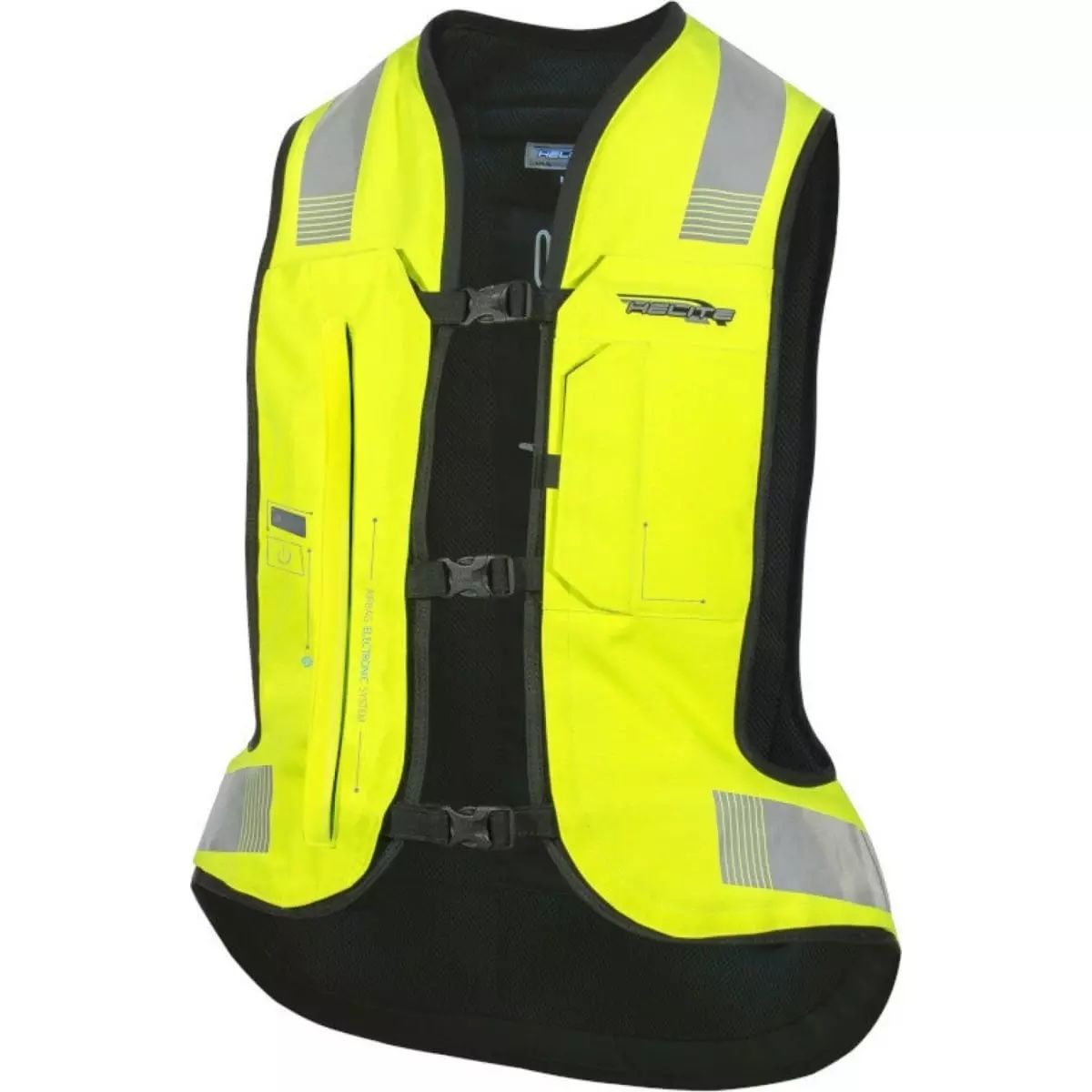
Helite E-Turtle 2 — The GPS that reassures... and overheats
The Helite E-Turtle 2 is the technological outlier of the test: it integrates a GPS module connected to multiple satellites to refine its fall detection. Tested from Differdange all the way to the Cévennes — over 700 kilometres under varied conditions including mountain roads — it did not trigger a single false deployment. Its cartridge can be changed by the user without a factory return up to the third deployment.
Its main weakness is thermal: above 30 degrees, the vest becomes uncomfortable. The start-up signal (indicator light) is considered insufficient. An important caveat regarding stationary impact coverage: without the optional fork sensor, the Helite cannot detect an external impact sustained without rider movement. On objective criteria, its weight of 1,900 g (2/5), its estimated battery life of around twenty hours (2/5) and its price of 730 euros (2/5) weigh it down heavily; only its deployment time of 100 ms (4/5) allows it to salvage a few points.
Weighted final score: 12.2/20. Convincing GPS technology, but penalised on numerous criteria.
Our verdict
The Bering Protect Air Evo delivers the best performance in the test, claiming top spot with an overall score of 17/20. Its cable system, often perceived as outdated, proves to be an asset on objective criteria: no battery to manage, unlimited autonomy, lowest price point, low weight. The Alpinestars Tech-Air 5 Plasma follows close behind (16/20) and remains the undisputed technical benchmark. Street/track versatility, automatic zip activation, and no incident across more than 960 kilometres. These are the two obvious choices depending on budget.
Behind them, the Dainese Smart Air (13.9/20) falters solely on its too-short battery life — a real obstacle in daily use. The Alpinestars Tech-Air 3 V2 (12.4/20) and the Helite E-Turtle 2 (12.2/20) bring up the rear: the former suffers from a reliability incident and inadequate point-of-sale training; the latter, despite its convincing GPS technology, is penalised across several criteria.
One final point not to overlook when making a choice: the question of stationary deployment. The Alpinestars vests and the Dainese handle this natively. The Bering, being cable-operated, cannot respond without rider movement. The Helite requires the optional fork sensor to cover this scenario. In a context of dense traffic, this criterion may tip the final decision.
One conclusion holds regardless of position in our ranking: the best airbag vest is the one you actually put on for every ride. And good news for Luxembourg’s motorcyclists: our test shows that the models available in local shops display an overall serious level of quality. Investing in this protection is always the right call.
Test carried out by ACL testers over several weeks. Shared protocol: minimum 7 days of real-world use, varied routes, standardised evaluation grid with multiple weightings. Prices recorded at list price, without member discounts.
This test was carried out with the support of AXA Luxembourg