With 24 oldtimers per 1,000 inhabitants, the Grand Duchy stands as the continent’s most passionate country for classic cars. A deep dive into a phenomenon that goes far beyond a mere curiosity.
Luxembourg is a country of cars. With 678 automobiles per 1,000 inhabitants according to the latest Eurostat data, the Grand Duchy claims a spot on the European podium, just behind Italy (701 vehicles). Liechtenstein, outside the European Union, tops the list at 767. The continental average, meanwhile, plateaus at 560. But beyond this well-known automotive density — often explained by the weight of company cars and cross-border commuters — another, less expected figure catches the eye: Luxembourg is also the European champion of historic vehicles.
More than 30,000 vehicles over 30 years old
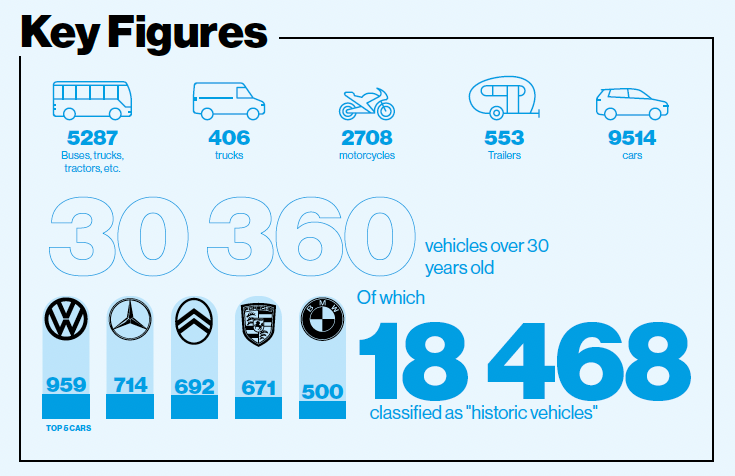
At the end of 2025, the Luxembourg vehicle fleet included 30,360 vehicles over 30 years of age. Among them, 18,468 officially hold “historic vehicle” status. This status, regulated since 2016, is no longer automatic: it requires a minimum age of 30 years and a technical report certifying the vehicle’s original condition.
And cars are not the only ones concerned. Of these 18,468 historic vehicles, there are also 5,287 buses, trucks, tractors and other utility vehicles, 2,708 two-wheelers, three-wheelers and quadricycles, 553 trailers and 406 vans. A rolling heritage of astonishing diversity for such a small territory.
Relative to a population of approximately 660,000 inhabitants, the ratio reaches 24.2 oldtimers per 1,000 inhabitants — a figure that places Luxembourg at the top of the continent, according to cross-referenced data from the Fédération Internationale des Véhicules Anciens (FIVA) and Eurostat.
A Europe at different speeds
This result takes on its full significance at the European scale. The United Kingdom, widely renowned for its “classic car” culture, shows a ratio of 22.7 oldtimers per 1,000 inhabitants. Germany, home to approximately 1.2 million historic vehicles — one of the largest fleets on the continent in absolute terms — does not exceed 14.3 per 1,000 due to its population of 84 million.
Belgium and Switzerland follow with comparable densities, at 12.8 and 12.5 per 1,000 inhabitants respectively. The Netherlands and Portugal sit at around 11, buoyed by a dynamic classic car culture. As for France and Italy, each credited with approximately 400,000 historic vehicles, their ratios drop to 5.9 and 6.8, diluted by far larger populations. At the bottom of the rankings, the countries of Central and Eastern Europe reflect a different relationship with the classic car: Poland stands at 1.1 per 1,000 inhabitants, Hungary at 3.1.
Volkswagen ahead of Citroën and Mercedes
On the brand front, data from the Société Nationale de Circulation Automobile (SNCA) holds a few surprises. Across all historic vehicles combined — cars, motorcycles, trucks, tractors — Volkswagen dominates the rankings with 1,095 vehicles, ahead of Mercedes (815) and Citroën (773). Porsche follows with 699 units, then BMW (645), Fiat (622), Deutz (619) and Fendt (609). The presence of these last two brands, both tractor specialists, is a reminder that Luxembourg’s rolling heritage also has roots in the agricultural world. Honda (553) and Renault (474) complete this eclectic top 10.
Focusing on cars only, the rankings tighten: Volkswagen remains in the lead (959), closely followed by Citroën (714), Mercedes (692), Porsche (671) and BMW (500). The Beetle and the 2CV thus rub shoulders with 911s and S-Classes in the garages of the Grand Duchy — proof that the passion for classics knows no boundaries of market segment.
A De Dion-Bouton from 1895, the oldest in the fleet
Among these thousands of veterans, one vehicle stands out for its exceptional age. The oldest car currently registered in Luxembourg is a De Dion-Bouton whose first registration dates back to 17 March 1895 — exactly 131 years ago. This French manufacturer, founded in 1883, was the world’s largest car maker in 1900.
Why does Luxembourg stand out?
No official statistics detail the reasons behind this enthusiasm, but several structural factors shed light on this exception. The country’s high purchasing power makes acquiring and maintaining a classic vehicle more accessible. Car culture is deeply embedded in daily life: Luxembourg has lived with and through the car for decades. The short distances to be covered allow regular use without the constraints of larger countries.
Much more than a statistic
The strong presence of classic cars in Luxembourg is not merely an accounting fact. It speaks to a singular identity: that of a country where the car, beyond daily mobility, remains a cultural object, a link between generations, sometimes a family inheritance. FIVA surveys show that across Europe, owning a historic vehicle is motivated more by emotion and the pleasure of driving than by any investment objective.
European champion of oldtimer density — an unexpected title for such a small territory — reflects a deeply rooted reality. Here, classic cars are not relics. They remain a living part of the heritage — and of the pleasure of driving.