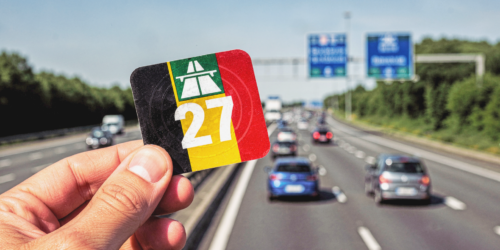
Published on 13 July 2026, our article on Belgium’s forthcoming road vignette prompted a large number of reactions on our social media channels. Beyond the often polarised opinions, several questions kept coming up. Is a Luxembourg vignette being considered? Is the Belgian mechanism compatible with EU law? What about motorhomes or households with several cars? Here are our answers.
A reminder is needed before going into detail. What was announced on 10 July 2026 is a political and governmental agreement in principle between Belgium’s three Regions. It is not yet law: the text will need to take the form of a cooperation agreement, be approved by the three regional parliaments, and then be notified to the European Commission. Belgian authorities therefore still have several months, until the planned entry into force on 1 May 2027, to refine the practical arrangements and rules of application so as to cover every situation. The answers below are based on current announcements and may change once the final texts are adopted.
So when will Luxembourg introduce its own vignette?
This is by far the most frequent question. The government’s official position is both clear and recent. On 26 February 2026, in response to a parliamentary question from MP Marc Goergen (Piratepartei), the Minister for Mobility and Public Works, Yuriko Backes, wrote: “The coalition agreement does not provide for the introduction of a toll for the use of the country’s entire road network. There is therefore neither a project nor any thinking on this matter.” The only exception already in force is the Eurovignette, which applies solely to lorries of 12 tonnes and above.
Belgium’s announcement on 10 July nonetheless revived the debate in the Chamber of Deputies. On Tuesday 14 July 2026, MPs Marc Goergen and Sven Clement (Piratepartei) tabled a motion proposing to replace the current car tax, paid only by residents, with a vignette system to which every vehicle using Luxembourg’s road network would contribute, whether registered domestically or abroad. Revenue would, according to the text, be earmarked for road maintenance. The same day, MP Yves Cruchten (LSAP) tabled an opposing motion calling on the government to oppose the introduction of the Belgian vignette. In short: no Luxembourg vignette is currently planned, but the parliamentary debate is now open.
Belgian residents will be compensated through taxation: does this comply with EU law?
Several readers rightly pointed to the most sensitive aspect of this issue. For Belgian motorists, the change is billed as cost-neutral: Flanders and Wallonia plan to lower the circulation tax to offset the cost of the vignette. Foreign drivers, however, will pay without any such offset.
This arrangement inevitably recalls the German precedent. In its ruling of 18 June 2019 (Case C-591/17, Austria v Germany), the Court of Justice of the European Union struck down the German vignette precisely because it was coupled with a reduction in vehicle tax reserved for German owners. The Court found this to constitute indirect discrimination on grounds of nationality, since the economic burden fell in practice solely on foreign drivers.
Belgium’s three Regions are trying to avoid this pitfall by formally separating the two issues: on one side, the vignette, applied at an identical rate for everyone; on the other, a reform of vehicle taxation. The project will need to be notified to the European Commission. It remains to be seen whether two legally distinct but economically linked measures will be enough to sidestep the 2019 case law. This is currently the main risk hanging over Belgium’s timetable.
Will Belgian cross-border workers be able to have their employer pay for the vignette?
More than 50,000 cross-border workers living in Belgium commute to Luxembourg. For those who make the journey in their own car registered in Belgium, the question barely arises: like all Belgian residents, they will benefit from the compensation provided through the lower circulation tax.
The situation is different for those who drive a company car registered in Luxembourg. As the vignette is tied to the number plate, the Luxembourg leasing vehicle will need its own vignette, costing 90 to 100 euros a year for a recent model, with no Belgian tax offset in return.
Nothing prevents an employee from asking their employer to cover this vignette. There is no legal obligation to do so: the matter is left to individual negotiation or company policy. For company cars, the most likely solution will come from leasing companies, which already manage Luxembourg’s circulation tax and could fold the Belgian vignette into the service packages they offer businesses. The cost would then be absorbed into the monthly lease payment, without changing the driver’s benefit in kind, which is calculated as a flat rate based on the vehicle’s value.
Employers who take this route will nonetheless need to weigh up a question of internal fairness. Covering the vignette only for commuters from Belgium would create an additional advantage over colleagues at the same company who live in Luxembourg, France or Germany and cover their own travel costs. It is up to each business to find its own balance, or to accept this imbalance.
What about motorhomes over 3.5 tonnes?
The vignette applies to vehicles with a maximum authorised mass of up to 3.5 tonnes, motorhomes included. The vast majority of motorhomes fall precisely into this category: most models are approved at 3.5 tonnes so they can be driven on a category B licence, with an unladen weight generally around 3 to 3.2 tonnes, which leaves only a small payload for passengers and luggage. These vehicles will therefore have to pay the vignette, just like a car.
That leaves heavier models, approved at 4 tonnes and above, which require a C1 licence. These escape the vignette, which is reserved for vehicles under 3.5 tonnes. Nor do they fall under Belgium’s kilometre charge, which applies only to vehicles used for the transport of goods. Under current announcements, a 4- or 5-tonne motorhome would therefore, paradoxically, continue to travel free of charge while its 3.5-tonne counterpart pays. The final texts, still being drafted, could correct this asymmetry.
We have two cars at home: will we have to pay twice?
Yes, if both vehicles are driven in Belgium. The vignette is entirely digital and tied to the registration number: it follows the vehicle, not the driver, and cannot be transferred from one number plate to another. This is the same principle as the Swiss and Austrian digital vignettes. For a second vehicle used only occasionally across the border, short-term options remain the sensible choice: from 8.10 to 11.25 euros a day depending on the engine, compared with 90 to 125 euros for the annual vignette. The same logic applies to classic cars: a vehicle from before 2005 taken out only a few times a year will pay 11.25 euros per trip rather than 125 euros a year.
What about motorbikes? And coaches to Charleroi?
Two quick answers to finish. Motorbikes, scooters and mopeds are exempt from the vignette. So are coaches: bus links to Charleroi Airport will therefore see no extra cost. Finally, a reminder that Belgian municipal roads also remain outside the scope of the vignette.
And what does the ACL think?
The ACL champions mobility in all its forms. That mobility must, however, be able to rely on reliable and safe infrastructure, which requires sustainable funding for its upkeep. Several European countries, such as France, Italy, Austria and Switzerland, have long charged for the use of their motorways, whether through tolls or vignettes. Belgium has made a different governance choice, one which it is not for the ACL to judge.
The club does not dispute the principle that infrastructure must be properly funded. It does, however, believe that the future system will need to be simple, transparent and compliant with EU law. It will pay close attention to how the system is implemented in practice and its consequences for road users, particularly in a region where cross-border travel is part of daily life for hundreds of thousands of people.
The club does, however, hope that the revenue announced will genuinely be invested in maintaining and improving Belgium’s road network, for the benefit of all users, residents and foreigners alike. The ACL will continue to follow the matter closely and keep its members informed at every stage, up to the planned entry into force on 1 May 2027.