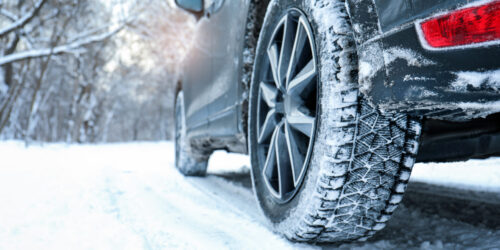
How many millimetres of tread do you actually need to drive safely? European motoring clubs, the ACL among them, now put a figure on it in a first-of-its-kind joint study.
Five 185/65 R15 winter tyres (Bridgestone Blizzak LM 005, Michelin Alpin 7, Kumho WinterCraft WP52+, Vredestein Wintrac and Linglong Sport Master Winter) were tested new, then mechanically shaved down to 4 mm and again to 2 mm. Eight categories were measured on track (wet braking and wet handling, straight-line and cornering aquaplaning, lateral grip, traction, snow braking and snow handling). Five findings stand out.
4 mm is no safety cushion
Across almost every test, safety falls as the tread wears, which confirms the advice to replace winter tyres once they reach 4 mm. That threshold is not a peak of safety, though. It marks the start of a phase in which the losses accelerate. Wet braking shows this clearly. Stopping distances averaged 31.9 m when new and barely moved at 4 mm (31.4 m), before stretching to 37.3 m at 2 mm, a rise of 17%. Kumho suffered most, jumping from 31.4 m to 38.9 m (up 25%). At 80 km/h with 30 m of road before an obstacle, the impact speed would climb from 15 km/h on new tyres to roughly 37 km/h at 2 mm.
The real danger is aquaplaning, not braking
This is the discipline most sensitive to wear. In a straight line, aquaplaning resistance falls by an average of 12.4% at 4 mm and 22.5% at 2 mm. In corners the decline is dramatic, down 24.7% at 4 mm and 52.2% at 2 mm, more than half the original reserves. Bridgestone contains the damage (-22.6%, then -38.3%), while Michelin fares worst, sliding from -23.2% to -61.2%, the steepest loss in the test. Vredestein goes from -28.9% to -56.2%, Kumho from -25.2% to -54.0% and Linglong from -23.8% to -51.5%. For comparison, wet cornering grip at constant speed, with no aquaplaning involved, loses only 4% on average at 2 mm. Water is what makes the difference.
Combined manoeuvres expose worn tyres most
The wet handling test, which combines braking, acceleration and changes of direction, tells more than the isolated exercises. Lap times rise by 1.8% at 4 mm and by 5.4% in total at 2 mm, an average of 4.5 seconds. The average score falls from 2.4 when new to 3.4 at 4 mm and 4.7 at 2 mm, crossing into the “inadequate” band on the German scale used by the ADAC. Bridgestone remains the safest (86.1 s to 89.0 s, score from 1.25 to 3.0), while Michelin drops furthest, from 88.9 s to 94.9 s, its score sliding from 3.0 to 6.0, the worst mark available.
On snow, the order reverses
No brand leads everywhere. In snow traction (down 8.8% on average at 4 mm and 15.9% at 2 mm), Linglong stands out for its consistency (-2.0%, then -7.9%), whereas Bridgestone, so strong in the wet, falls the furthest (-15.9%, then -28.5%). Michelin, off the pace in the wet, holds up surprisingly well on snow in both traction and braking (-9.5%, then -9.4%, essentially unchanged). Bridgestone is again the hardest hit in snow braking (-20.4%, then -40.9%). In snow handling, so demanding that the ADAC had to extend its scale beyond 6, the average moves from 5.38 at 4 mm to 7.17 at 2 mm. Bridgestone records its worst result there, 8.25 at 4 mm, already off the scale, and 11.6 at 2 mm.
The millimetres matter more than the brand
No tyre makes up for lost tread across the full set of tests. A premium tyre at 2 mm never recovers the reserves of a mid-range tyre at 4 mm. The gaps between premium, mid-range and budget ranges prove smaller than the effect of wear itself. The study also notes that visible sipes were no reliable guide to actual snow performance.
What to take away
Waiting for the legal limit of 1.6 mm before changing winter tyres means driving for thousands of kilometres with a significant share of the safety reserve already gone, and it is in the rain, rather than on snow, that this costs the most. Checking tread depth regularly, with a gauge or, failing that, the silver rim of a 2-euro coin (4 mm), remains the simplest habit. Travellers should note that legal minimums vary across Europe, 1.6 mm in Germany but 4 mm in Austria and the Czech Republic, a patchwork the ADAC wants harmonised.