Working with several European automobile clubs, we tested sixteen winter tires in size 225/50 R17. The verdict: four models clearly stood out, while six ended up with a rating judged unsatisfactory. Between the best and the worst, the gap in wet braking distance reaches 11.6 meters.
Sixteen winter tires in size 225/50 R17 98V went through a full test programme run jointly by several automobile clubs, among them the Automobile Club du Luxembourg. Every measurement was taken on the same car, an Audi A4 Avant, inflated to the pressures specified by the manufacturer (2.7 / 2.4 bar). The field ranges from premium products to the cheapest budget offerings. The conclusion is blunt: what you save at the checkout, you pay for in safety.
In detail, four of the sixteen models earn a “good” rating and a full buying recommendation. Six others get no further than “satisfactory”. The last six are rated “unsatisfactory”: with each of them, the test car becomes imprecise on at least one surface, often two.
The podium
- Pirelli Cinturato Winter 3 (overall rating: 2.2)
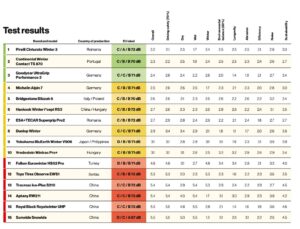
The Pirelli posts the best driving safety score in the test (2.1) and dominates the wet section with 1.7. Braking from 80 km/h on wet asphalt, it stopped in 34.7 meters, the shortest distance of the field. It also held out longest against hydroplaning, both in a straight line (85 km/h) and through a corner (3.2 m/s²), and scored 1.43 for handling on the wet circuit. On dry roads and in winter conditions it stays in the green, with a projected life of 43,100 kilometers. One criticism: the testers found its rolling noise intrusive inside the cabin, the poorest score of the field on a criterion assessed by ear. Measured from the outside, it is nevertheless one of the quietest tires here (70.9 dB(A)).
- Continental WinterContact TS 870 (overall rating: 2.3)
The Continental is the most consistent tire of the lot. It matches the Pirelli for braking on wet asphalt (34.7 m) and posts the best figure in the test on the second wet surface used, a concrete track (38.2 m). On snow and ice its braking distances are good (10.0 m from 30 km/h, 17.1 m from 20 km/h on ice). It offers a projected life of 43,200 kilometers and a low abrasion rate (74 mg/km/t). Its limits: imprecise steering on dry roads, snow behaviour just short of good, and a weight above the field average (10.4 kg).
- Goodyear UltraGrip Performance 3 (overall rating: 2.4)
The Goodyear narrowly misses a good driving safety score (2.6, because of its winter performance) but makes up for it with the best environmental balance of the three (2.0): 55,800 kilometers projected, the second longest life in the test, abrasion held to 62 mg/km/t and 9.6 kg on the scales. It is solid on dry and wet roads, less convincing in snow traction, ice braking and snow handling.
The fourth and last recommended tire is the Michelin Alpin 7 (overall rating: 2.5), the snow king of the quartet (1.7) and the lightest tire in the test (9.5 kg).
What the figures say
Longevity. A winter tire in this size lasts an average of 45,500 kilometers according to the testers’ projection. The spread runs from 32,000 kilometers for the Falken Eurowinter HS02 Pro to 59,300 kilometers for the Dunlop Winter. In practice, covering 60,000 winter kilometers takes a single set of Dunlops, but very nearly two sets of Falkens.
Wet braking. Every tire brakes on two wet surfaces, asphalt and concrete. On asphalt, the average distance from 80 km/h is 38.2 meters. The best (34.7 m) and the worst (46.3 m) are 11.6 meters apart, more than two car lengths.
Dry braking. From 100 km/h the spread is far narrower: 45.7 meters on average, within a range of 43.8 to 48.9 meters. On dry roads, every tire brakes more or less the same. It is under evasive manoeuvres and through corners that the field separates.
Snow and ice. From 30 km/h on packed snow, the average distance is 10.1 meters (9.4 to 11.6 m). On ice, from 20 km/h, it reaches 18.0 meters (16.5 to 19.5 m).
Noise and consumption. Pass-by noise measured to the ISO standard ranges from 70.3 to 74.6 dB(A), averaging 72.4. Consumption at 100 km/h varies between 5.2 and 5.8 l/100 km depending on the tire fitted, a difference of 0.6 liters on an identical car. Weight ranges from 9.5 to 11.4 kilograms per tire.
Abrasion. Particles released range from 54 to 98 mg/km/t, averaging 76, close to a factor of two between best and worst.
What about the EU tire label? It only tells part of the story. Its wet grip class sums up a single braking exercise, whereas the test assesses wet behaviour across five disciplines: braking on asphalt, braking on concrete, straight-line hydroplaning, hydroplaning through a corner and handling on a wet circuit. Hence some striking gaps. The Tracmax, the Aptany and the Royal Black all carry the same class C as perfectly decent tires, yet are rated unsatisfactory in the wet (5.4 to 5.5). The Sunwide takes the best noise class of the field (A, 67 dB) and finishes last. A test is a more reliable guide than the label alone.
The bottom three
Aptany RW211 (overall rating: 5.4)
A tire at odds with itself: good on snow (1.7), catastrophic everywhere else. It records the longest dry braking distance in the test (48.9 m from 100 km/h) and collapses in the wet, needing 43.7 meters on asphalt. On the wet circuit its handling score falls to 5.42. Its projected life stops at 36,400 kilometers and its pass-by noise reaches 74.5 dB(A), among the highest recorded.
Royal Black Royalwinter UHP (overall rating: 5.5)
The paradox of the test. On the environmental side it ticks almost every box: 55,600 kilometers of projected life, the lowest abrasion of the field (54 mg/km/t) and the lowest fuel consumption (5.2 l/100 km). But it is rated unsatisfactory on dry (4.8) and wet roads (5.5), with 43.8 meters of braking on asphalt and a resistance to straight-line hydroplaning that gives way as early as 63 km/h, the worst figure in the test. It is also the loudest tire from the outside (74.6 dB(A)), and it reaches the customer with production residues still on the rubber.
Sunwide Snowide (overall rating: 5.5)
The perfect trap. It is the best tire in the test on snow, and by a wide margin: 1.3 for winter behaviour, 0.61 for snow handling, 9.4 meters of braking on snow and 16.5 meters on ice, three outright records. On dry roads, though, it manages only 5.0, and 5.5 in the wet, with the longest braking distances of the field (46.3 m on asphalt, 50.9 m on concrete) and the weakest resistance to hydroplaning through a corner (1.5 m/s²). It also records the highest abrasion in the test (98 mg/km/t). A tire built for three snowy days a year, and dangerous on the other 362.
The clearest illustration is a direct comparison. Where the A4 Avant fitted with the Continental has already come to a standstill on the wet after about 35 meters, the same car on Sunwide tires is still travelling at 40 km/h and only stops twelve meters further on. On snow, the Tracmax Ice-Plus S210 needs 16 meters more than the Sunwide: at the point where the best tire has already stopped, it is still doing close to 35 km/h, faster than the limit in a 30 zone.
Buying advice
Always fit four tires of the same model and type, and check the pressure regularly, raising it when the car is loaded in line with the manufacturer’s figures. If tread depths differ, put the better tires on the rear axle: it is the rear axle that determines stability through corners. The European clubs recommend replacing a winter tire once the tread drops below 4 millimeters, well above the legal minimum, so as to keep a safety margin against hydroplaning. Go for recent models, check that all four tires carry the same production date (DOT code) and never buy new tires more than three years old.