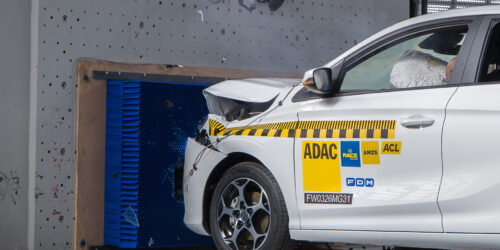
Euro NCAP is an independent European organisation that assesses the safety of new vehicles. It has now published its ‘Best in Class’ ranking of models tested in 2025. Cars from Mercedes-Benz, Tesla, Smart and Mini proved to be particularly safe.
Euro NCAP has published its ‘Best in Class’ ranking of models tested in 2025. It was a record year for the organisation in terms of the number of tests carried out. The rise of electric cars continued in 2025 and driver assistance systems became increasingly sophisticated.
Euro NCAP emphasises that, in a rapidly changing automotive world, manufacturers have succeeded in introducing innovations while meeting the high requirements of the tests. The cars were assessed in four safety categories: protection of adults, children and vulnerable road users, as well as driver assistance systems that support safe driving in order to prevent accidents or reduce their severity. Only vehicles that have safety equipment as standard and have received a five-star rating in the test can receive the ‘Best in Class’ award.
Award for Mercedes CLA
“Euro NCAP selects the best cars in their class to help consumers easily identify the best-performing vehicles. There have been some challenges in 2025, but it is nevertheless gratifying to see that the automotive industry remains committed to improving vehicle safety,” said Michiel van Ratingen, Secretary General of Euro NCAP, before announcing the top-rated model: ‘Mercedes has long believed in the importance of investing in vehicle safety. It therefore seems entirely appropriate that the CLA should receive the “Best Performance 2025” title as well as the “Best Small Family Car” title.’
The Mercedes-Benz CLA excelled in particular with its near-perfect performance in adult protection and is a benchmark in terms of protecting vulnerable road users. In particular, it features an active bonnet to protect pedestrians and a sophisticated autonomous emergency braking system. In the rankings, the CLA achieved 94 per cent in the “Adult Occupant” category, 89 per cent in “Child Occupant”, 93 per cent in “Vulnerable Road User” and 85 per cent in “Safety Assist” (for safety-related assistance systems). The model thus builds on the excellent results achieved by the previous generation in 2019.
Electric cars at the top
‘It was a very close competition,’ emphasised Michiel van Ratingen, referring to Mercedes’ proximity to Tesla and the market entry of new players: ‘Tesla was only a few points behind. New market entrants such as Firefly and Leapmotor show that global competition is continuing to intensify. This can only be beneficial for consumers who value safety as much as design, practicality, performance and running costs in their next car,’ he said.
Several electric reference models are at the top of the ranking. In the large family car category, the Tesla Model 3 stands out with balanced results in all safety categories. It scores 90 per cent for adult protection, 93 per cent for child protection, 89 per cent for vulnerable road user protection and 87 per cent for its assistance systems, with the protection of the youngest occupants rated particularly highly.
In the compact SUV category, the Tesla Model Y comes out on top with 91 per cent (adults), 93 per cent (children), 86 per cent (vulnerable road users) and 92 per cent (safety-related assistance systems), underlining the efficiency of its driver assistance systems.
Mini: Compact and safe
In the family SUV segment, the smart #5 made a remarkable entry with scores of 88, 93, 84 and 92 percent, proving that this rise in popularity did not come at the expense of passenger protection. In the small car category, the MINI Cooper E shows that a compact format can go hand in hand with safety: 89 per cent (adults), 87 per cent (children), 77 per cent (vulnerable road users) and 79 per cent (safety-related assistance systems). The Polestar 3 is a convincing luxury SUV saloon thanks to its structural integrity, excellent results in child protection and a range of new-generation driver assistance systems.
Beyond the raw figures, Euro NCAP said that safety technology is catching up and test requirements are increasingly being met: in the case of electric vehicles, manufacturers are no longer content with their models keeping pace with combustion engines. Electric cars often surpass them in terms of safety. ‘Looking ahead to 2026, we encourage all manufacturers to maintain this momentum towards Vision Zero,’ emphasised programme director Dr Aled Williams.
Ranking helps consumers choose their car
Euro NCAP also announced that it will change its assessment procedure from 2026. However, the five-star rating will remain a valid and reliable indicator of the safety performance of a new model. The current ranking shows consumers that safety and attractive design can go hand in hand without compromising on driving pleasure or everyday practicality. The ranking of the best models is therefore a useful guide when choosing a new car.