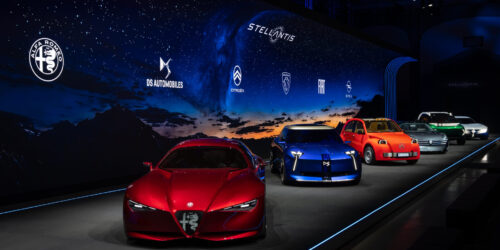
Behind the six concept cars shown at Meudon sits a precise industrial plan, two new platforms and a promise of affordable electric cars built in Europe.
An 1879 airship hangar as a stage for the future, the irony was hard to miss. At the Hangar Y in Meudon, Stellantis used the eve of the Paris Motor Show to display six concept cars and, above all, the method that produced them.
Six brands, six handwritings
“Six different answers to one common goal, creating our brands’ future icons now.” Gilles Vidal, head of design for Enlarged Europe, insists on differentiation. Every brand turns up with its own vocabulary. Peugeot pushes its “Feline Future” design language, Alfa Romeo has coined “Bellezza Necessaria”, a beauty that strips out anything superfluous, Opel sharpens its “bold and pure” register, DS Automobiles claims a “Design Intelligence” aimed at cutting the number of components, and Citroën goes for cheerful simplicity. “Design is a 360-degree discipline, from proportions to the smallest button inside, or even the smallest piece of graphic design on a screen,” Vidal says. He is explicit about wanting to give the group’s cars “a soul”. Lancia, Maserati and Jeep were absent that evening, though projects are under way, he hinted.
That diversity is not merely a matter of taste. It forms the first pillar of the FaSTLAne 2030 plan unveiled last May. “Each of our brands has a distinctive identity and mission,” says Emanuele Cappellano, chief operating officer for Enlarged Europe. By 2030 the group promises more than 50 launches in Europe, market coverage widened by 25 per cent and powertrain coverage up by 35 per cent.
Two platforms, two promises
The second pillar is industrial. STLA One, which underpins the Peugeot RCZ Vision, is meant to deliver new features while cutting costs by 20 per cent against the current product generation. The second platform, named iCar, concerns European buyers more directly. Designed for low-cost electric city cars built in Europe, it will carry the production 2 CV due in 2028 for less than 15,000 euros.
John Elkann, chairman of the board, sees it as a political answer as much as an industrial one. “We strongly wanted to provide an answer to millions of Europeans who are looking for an affordable electric car,” he said, invoking a responsibility shared with the European institutions. The message to Brussels is unambiguous, since the regulatory framework for small electric cars is still being written.
A lead worth defending
The third pillar sounds less spectacular. It consists of filling the plants better, either by repurposing them or by sharing capacity with partners. Stellantis sold 2.5 million vehicles in Europe in 2025, close to half its global volume, and reports sales growth of more than 7 per cent in the first half of 2026 for a market share up by 0.3 points. Second-largest manufacturer on the continent, first in light commercial vehicles and city cars, number one in France and Italy, the group also knows that 34 million Europeans drive one of its cars today.
That leaves execution, in a context Cappellano himself calls stormy in geopolitical terms, with an uneven energy transition and a European regulatory framework that remains unclear. “Our brands are powered by a remarkable heritage, but we are not defined by the past,” he says.